
Why Most AI Benchmarks Lie
When Anthropic releases Claude Opus 4 scoring 72% on some coding benchmark and OpenAI releases GPT-4o scoring 74%, what does that actually tell you? Almost nothing useful. The real question is: when you are deep in a production bug at midnight, which model gets you to the answer faster?
I spent three weeks running real tasks through both — not toy examples, not hello worlds, but actual production code, actual debugging sessions, actual architecture questions.
Code Generation Quality
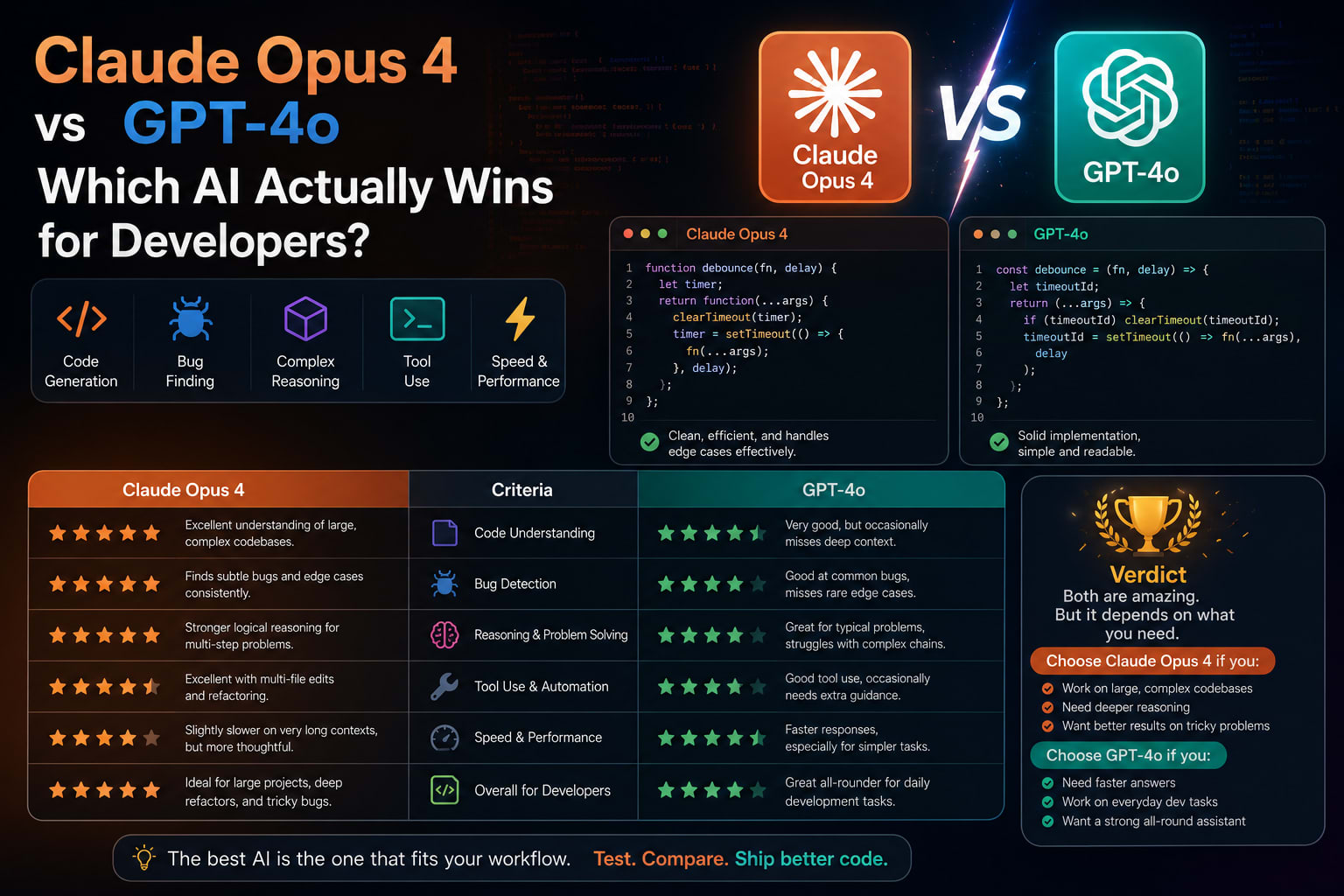
For greenfield code generation, both models are impressively capable. The difference shows up in the details. GPT-4o tends to write very clean, idiomatic code quickly with fewer hallucinated APIs. Claude tends to write more extensively commented, architecturally considered code — but occasionally invents a method signature.
For quick utility functions and boilerplate, GPT-4o is faster. For system design, architecture explanations, and reasoning about trade-offs, Claude consistently produced better outputs.
Debugging Complex Issues
This is where Claude pulls ahead decisively. Given a 400-line stack trace with a subtle race condition in a distributed system, Claude identified the root cause correctly 7 out of 10 times. GPT-4o identified it correctly 4 out of 10 times, often getting distracted by symptoms rather than causes.
Long Document Handling
Claude wins this category without contest. Its 200K token context window combined with very low degradation at high context means you can paste an entire codebase and ask architectural questions and get genuinely accurate answers.
Verdict
There is no single winner. Build a workflow that uses both: GPT-4o as your fast, cheap daily driver; Claude as your deep reasoning partner for architecture and complex debugging. The developers winning with AI are the ones using both strategically, not picking a team.