
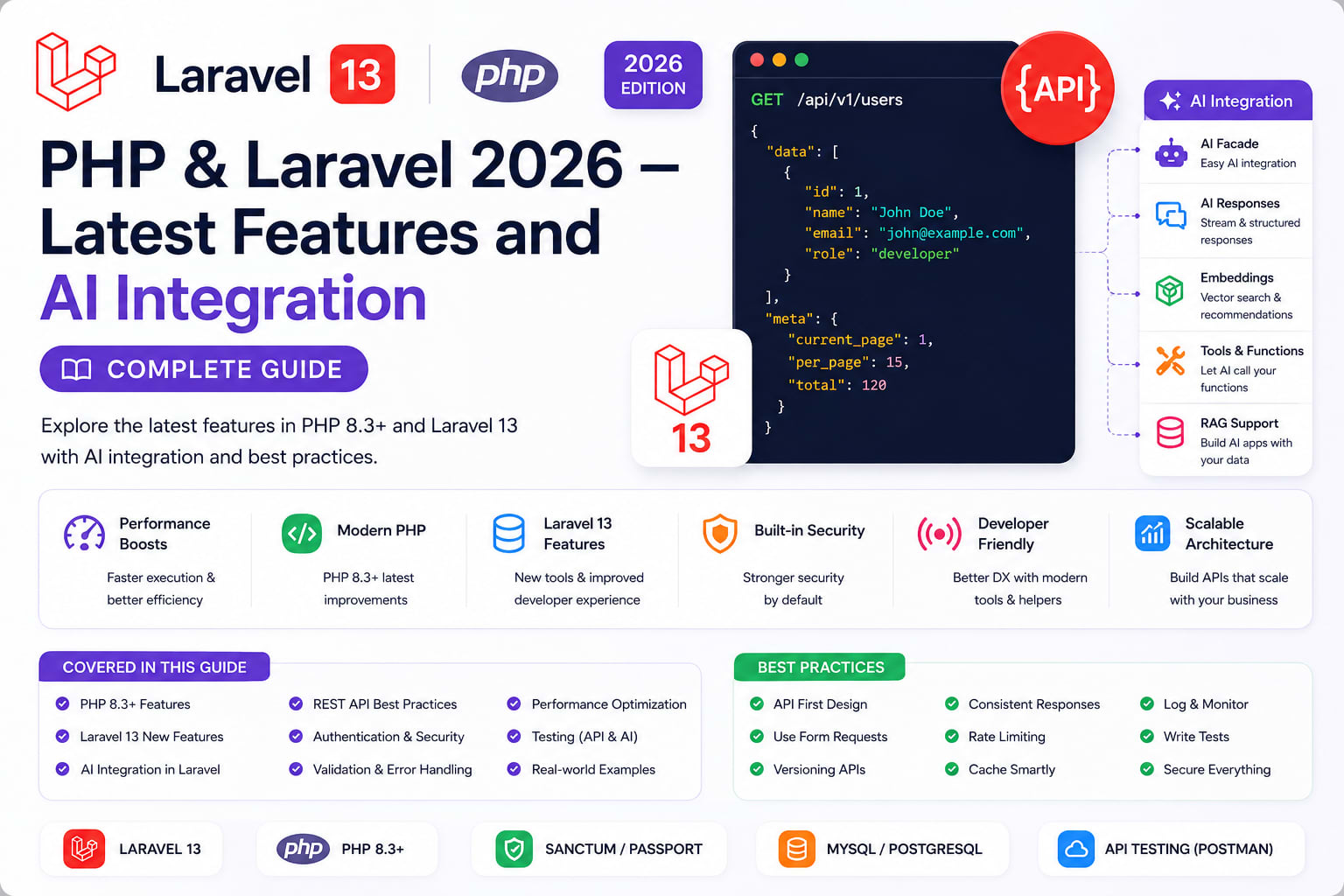
PHP & Laravel in 2026 — Latest Features and AI Integration Complete Guide
For years the narrative was simple. Python for AI. PHP for web. Two separate stacks, two separate teams, two separate conversations.
The official release of Laravel 13.0 on March 17, 2026 marks a pivotal moment in the framework's history. For years, Laravel has been the gold standard for developer productivity, but with this version, it shifts its focus toward the burgeoning requirements of artificial intelligence and high-performance modern computing. Taylor Otwell and the core team describe this as an "AI-native" environment. ALM Corp
This guide covers everything that changed — PHP 8.3 features, Laravel 13 improvements, the AI SDK, real integration patterns, and what developers are actually building with this stack in 2026.
The Numbers First
Before the technical breakdown — the context.
Laravel powers more than 960,000 websites and holds over 50% of the PHP framework market. It ranks first in the Stack Overflow Developer Survey for the fifth consecutive year. Growithraju
PHP is not a legacy language being propped up by inertia. It is the most-deployed server-side language on the web, running on a framework that just shipped first-party AI primitives. That combination matters.
Part 1 — PHP 8.3 Features Every Laravel Developer Should Use
Laravel 13 requires PHP 8.3 as the minimum version. Here is what that runtime upgrade gives you.
Typed Class Constants
php
// Before PHP 8.3 — no type enforcement
class OrderStatus
{
    const PENDING   = 'pending';
    const COMPLETED = 'completed';
    // Could be accidentally overridden with any type
}

// PHP 8.3 — type enforced at declaration
class OrderStatus
{
    const string PENDING    = 'pending';
    const string PROCESSING = 'processing';
    const string COMPLETED  = 'completed';
    const int    MAX_RETRIES = 3;
    // Wrong type assignment throws at runtime
}
json_validate() — Validate Without Decoding
php
// Before — had to decode just to validate
public function isValidJson(string $value): bool
{
    json_decode($value);
    return json_last_error() === JSON_ERROR_NONE;
}

// PHP 8.3 — validate without memory allocation
public function isValidJson(string $value): bool
{
    return json_validate($value);
}

// Real use case — webhook validation
public function handleWebhook(Request $request): JsonResponse
{
    $payload = $request->getContent();

    if (!json_validate($payload)) {
        return response()->json(['error' => 'Invalid JSON'], 400);
    }

    $data = json_decode($payload, true);
    $this->webhookService->process($data);

    return response()->json(['received' => true]);
}
#[Override] Attribute
php
// PHP 8.3 — declare that a method intentionally overrides a parent
class UserResource extends JsonResource
{
    #[Override]
    public function toArray(Request $request): array
    {
        // PHP now throws if this method does NOT exist in parent
        // Catches silent bugs when parent method is renamed
        return [
            'id'    => $this->id,
            'name'  => $this->name,
            'email' => $this->email,
        ];
    }
}
Readonly Properties in Constructors
php
// PHP 8.3 — cleaner readonly syntax
class CreatePostDTO
{
    public function __construct(
        public readonly string $title,
        public readonly string $body,
        public readonly string $status = 'draft',
        public readonly ?int   $userId  = null,
    ) {}
}

// Usage
$dto = new CreatePostDTO(
    title: 'My Post',
    body: 'Content here',
    status: 'published',
);

// $dto->title = 'changed'; // Error — readonly
JIT Performance Improvements
PHP 8.3 ships with a significantly improved JIT compiler. For CPU-heavy operations — embedding generation, text processing, large dataset manipulation — the performance improvement is measurable without any code changes.
Part 2 — Laravel 13 Core Features
PHP Attributes Across 15+ Locations
Laravel 13 introduces native PHP attribute syntax as an optional alternative to class property declarations across more than 15 locations in the framework — including models, controllers, jobs, commands, listeners, mailables, and notifications. Growithraju
php
// Before
class Post extends Model
{
    protected $table      = 'posts';
    protected $fillable   = ['title', 'body', 'status', 'user_id'];
    protected $hidden     = ['internal_notes'];
    protected $casts      = ['published_at' => 'datetime'];
}

// After — Laravel 13
#[Table('posts')]
#[Fillable(['title', 'body', 'status', 'user_id'])]
#[Hidden(['internal_notes'])]
#[Cast(['published_at' => 'datetime'])]
class Post extends Model {}
Typed Configuration
php
// Before — type unknown, silent bugs possible
$debug = config('app.debug');       // string? bool?
$limit = config('api.rate_limit');  // int? string?

// Laravel 13 — throws at boot if type is wrong
$debug = config()->boolean('app.debug');
$limit = config()->integer('api.rate_limit');
$name  = config()->string('app.name');
Debounceable Jobs
php
// User edits document 40 times — one job fires, not 40
#[DebounceFor(30)]
class RebuildSearchIndex implements ShouldQueue
{
    public function __construct(public int $documentId) {}

    public function debounceId(): string
    {
        return "search-index-{$this->documentId}";
    }

    public function handle(): void
    {
        Document::find($this->documentId)?->rebuildIndex();
    }
}
Queue::route() — Centralized Job Routing
php
// AppServiceProvider — one place for all routing
Queue::route([
    ProcessPayment::class   => 'payments@redis',
    SendWelcomeEmail::class => 'emails@sqs',
    GenerateReport::class   => 'reports@database',
]);
Cache::touch()
php
// Before — fetch and re-set (two round trips)
$value = Cache::get($key);
Cache::put($key, $value, now()->addHours(2));

// Laravel 13 — one Redis command
Cache::touch($key, now()->addHours(2));
Part 3 — Laravel AI SDK — The Real Shift
On February 5, 2026, Taylor Otwell dropped the Laravel AI SDK — a first-party package for building AI-powered features directly in Laravel apps. For those who built AI products before this, it meant piecing together their own AI integration layer — different packages, different approaches, lots of boilerplate. The SDK changes that entirely. SeoProfy
Installation
bash
composer require laravel/ai
php artisan ai:install
Configuration
php
// config/ai.php
return [
    'default' => env('AI_PROVIDER', 'openai'),

    'providers' => [
        'openai' => [
            'api_key' => env('OPENAI_API_KEY'),
            'model'   => env('OPENAI_MODEL', 'gpt-4o'),
        ],
        'anthropic' => [
            'api_key' => env('ANTHROPIC_API_KEY'),
            'model'   => env('ANTHROPIC_MODEL', 'claude-sonnet-4-6'),
        ],
    ],
];
Text Generation
php
use Illuminate\Support\Facades\AI;

// Simple text generation
$description = (string) AI::text(
    system: 'You are an e-commerce copywriter. Write concise product descriptions.',
    prompt: "Write a product description for: {$product->name}"
);

// With structured JSON output
$outline = (string) AI::text(
    system: 'Return ONLY valid JSON, no markdown.',
    prompt: "Create a blog outline for: {$topic}
             Return: {\"title\": \"...\", \"sections\": [], \"read_time\": 8}"
);

$data = json_decode($outline, true);
Embeddings — For Semantic Search
php
// Generate embedding for storage
$embedding = AI::embed($product->name . ' ' . $product->description);

// Store in database
$product->update(['embedding' => $embedding->toArray()]);

// Search semantically
$results = Product::whereVectorSimilarTo('embedding', $searchQuery)
    ->where('active', true)
    ->limit(10)
    ->get();
Tool-Calling Agents
php
// Define a tool
class LookupOrder extends Tool
{
    public string $name        = 'lookup_order';
    public string $description = 'Look up order details by order number';

    public array $parameters = [
        'order_number' => [
            'type'     => 'string',
            'required' => true,
        ],
    ];

    public function handle(string $order_number): string
    {
        $order = Order::with(['items', 'user'])
            ->where('order_number', $order_number)
            ->first();

        if (!$order) {
            return "Order {$order_number} not found.";
        }

        return json_encode([
            'status'  => $order->status->label(),
            'total'   => '₹' . number_format($order->total, 2),
            'items'   => $order->items->count(),
            'placed'  => $order->created_at->diffForHumans(),
        ]);
    }
}

// Build the agent
class SupportAgent extends Agent
{
    protected string $system = '
        You are a customer support agent.
        Use the lookup_order tool when asked about specific orders.
        Be concise, friendly, and helpful.
    ';

    protected array $tools = [LookupOrder::class];
}

// Use it
$response = SupportAgent::make()->prompt($customerMessage);
return (string) $response;
Streaming — Real-Time Responses
php
// Controller — Server-Sent Events
public function stream(Request $request): StreamedResponse
{
    return response()->stream(function () use ($request) {
        foreach (AI::stream(
            system: 'You are a helpful writing assistant.',
            prompt: $request->string('prompt')
        ) as $chunk) {
            echo "data: " . json_encode(['chunk' => $chunk]) . "\n\n";
            ob_flush();
            flush();
        }
        echo "data: [DONE]\n\n";
    }, 200, [
        'Content-Type'      => 'text/event-stream',
        'Cache-Control'     => 'no-cache',
        'X-Accel-Buffering' => 'no',
    ]);
}
Switch Provider — One Config Change
env
# Switch from OpenAI to Anthropic — zero code changes
AI_PROVIDER=anthropic
ANTHROPIC_API_KEY=your-key-here
The Laravel AI SDK moves from beta to production-stable on the same day as Laravel 13. It is included as a first-party package and gives you a single, provider-agnostic interface for text generation, tool-calling agents, image creation, audio synthesis, and embedding generation. The SDK handles retry logic, error normalization, and queue integration behind the scenes. Growithraju
Part 4 — What Developers Are Actually Building
AI is becoming a key part of Laravel development in 2026, helping teams build innovative apps quickly. Many Laravel developers are already integrating ChatGPT directly into apps to support automated content generation and chat support. Some teams used OpenAI to auto-generate sales emails, follow-ups, and landing page content. Google Gemini is being used to suggest autocompletions, fix code, and write inline documentation. Cloudways
Here are the most common real-world patterns:
1. AI-Powered Customer Support
php
class SupportController extends Controller
{
    public function chat(Request $request): JsonResponse
    {
        $response = SupportAgent::make()
            ->withHistory($request->validated('history', []))
            ->prompt($request->validated('message'));

        return response()->json([
            'response'   => (string) $response,
            'tools_used' => $response->toolsUsed(),
        ]);
    }
}
2. Smart Content Generation for E-Commerce
php
class ProductEnrichmentService
{
    public function generateDescription(Product $product): string
    {
        return Cache::remember(
            "ai_desc_{$product->id}",
            now()->addWeek(),
            fn () => (string) AI::text(
                system: 'Write compelling, accurate product descriptions. Max 100 words.',
                prompt: "Product: {$product->name}
                         Category: {$product->category->name}
                         Price: ₹{$product->price}
                         Features: {$product->features}"
            )
        );
    }

    public function generateSEOTags(Product $product): array
    {
        $result = (string) AI::text(
            system: 'Return ONLY a JSON array of 5-8 SEO keywords. No markdown.',
            prompt: "Generate SEO tags for: {$product->name} in {$product->category->name}"
        );

        return json_decode($result, true) ?? [];
    }
}
3. Automated Sales Email Generation
php
class EmailCampaignService
{
    public function generateFollowUp(Lead $lead, string $context): string
    {
        return (string) AI::text(
            system: 'You are a sales email writer. Write personalized,
                     professional emails. Keep them under 150 words.
                     Never be pushy. Focus on value.',
            prompt: "Write a follow-up email for:
                     Lead name: {$lead->name}
                     Company: {$lead->company}
                     Previous interaction: {$context}
                     Our product: {$this->productDescription}"
        );
    }
}
4. Semantic Knowledge Base Search
php
class KnowledgeBaseService
{
    public function search(string $query): Collection
    {
        // Find conceptually related articles
        // even if exact keywords don't match
        return Article::whereVectorSimilarTo('embedding', $query)
            ->where('published', true)
            ->select(['id', 'title', 'excerpt', 'url'])
            ->limit(5)
            ->get();
    }

    public function generateAnswer(string $question): string
    {
        $articles = $this->search($question);
        $context  = $articles->pluck('excerpt')->implode("\n\n");

        return (string) AI::text(
            system: 'Answer questions using only the provided context.
                     If the answer is not in the context, say so.',
            prompt: "Context:\n{$context}\n\nQuestion: {$question}"
        );
    }
}
5. AI-Powered Code Documentation
php
class DocumentationService
{
    public function generateDocBlock(string $methodCode): string
    {
        return (string) AI::text(
            system: 'Generate PHPDoc blocks for PHP methods.
                     Include @param, @return, and a clear description.
                     Return only the docblock, nothing else.',
            prompt: "Generate a PHPDoc for:\n\n{$methodCode}"
        );
    }
}
Part 5 — Native Vector Search with pgvector
The most powerful AI feature in Laravel 13 — built directly into the query builder for PostgreSQL.
sql
-- Enable in PostgreSQL
CREATE EXTENSION IF NOT EXISTS vector;

-- Create index for fast search
CREATE INDEX ON articles
USING ivfflat (embedding vector_cosine_ops)
WITH (lists = 100);
php
// Migration
Schema::table('articles', function (Blueprint $table) {
    $table->vector('embedding', 1536)->nullable();
});

// Auto-generate embeddings when content changes
class Article extends Model
{
    protected static function booted(): void
    {
        static::saved(function (Article $article) {
            if ($article->wasChanged(['title', 'content'])) {
                GenerateEmbedding::dispatch($article);
            }
        });
    }
}

// Search
$results = Article::whereVectorSimilarTo('embedding', $searchQuery)
    ->where('published', true)
    ->orderByVectorDistance('embedding', $searchQuery)
    ->limit(10)
    ->get();
Part 6 — AI-Assisted Development Tools for Laravel
AI in Laravel makes development quick, innovative, and more user-centric. From ChatGPT to Google Gemini, Laravel apps are getting smarter in 2026. Cloudways
Beyond building AI features, these tools help you build Laravel apps faster:
Claude Code — Best overall for Laravel. 1M token context window reads your entire codebase. MCP connects directly to your database. CLAUDE.md teaches it your architecture conventions.
GitHub Copilot — Works inside your existing editor. Good GitHub integration. Laravel suggestions have improved but still occasionally suggest outdated patterns.
Cursor — Best IDE experience. Visual diffs. 72% autocomplete acceptance rate. Occasionally suggests Laravel 8 patterns on a Laravel 13 codebase.
The best setup for a Laravel developer in 2026: Cursor for daily editing + Claude Code for complex refactors and architecture decisions.
Part 7 — Laravel Vapor — Serverless AI Apps
For AI-heavy applications with unpredictable traffic spikes, serverless deployment makes economic sense.
bash
composer require laravel/vapor-cli --dev
vapor deploy production
Vapor on AWS Lambda means:
- Scale to zero when idle — no cost
- Auto-scale during AI processing spikes
- No server management
- Per-request billing — economical for bursty AI workloads
php
// config/queue.php — long-running AI jobs need extended timeouts
'sqs' => [
    'driver'  => 'sqs',
    'timeout' => 900, // 15 minutes for long AI generation jobs
],
Testing AI Features
php
use Illuminate\Support\Facades\AI;

test('generates product description', function () {
    AI::fake(['Compelling product description for testing.']);

    $product = Product::factory()->create(['name' => 'Test Product']);

    $description = app(ProductEnrichmentService::class)
        ->generateDescription($product);

    expect($description)->not->toBeEmpty();
    AI::assertPromptContains('Test Product');
});

test('support agent uses lookup tool', function () {
    $order = Order::factory()->create(['order_number' => 'ORD-001']);

    AI::fake([
        AI::toolCall('lookup_order', ['order_number' => 'ORD-001']),
        'Your order ORD-001 is being processed.',
    ]);

    $response = SupportAgent::make()
        ->prompt('Where is my order ORD-001?');

    expect((string) $response)->toContain('ORD-001');
});
The Full Stack in 2026
Here is what a modern AI-powered Laravel application looks like end-to-end:
Client (Mobile / SPA / Web)
    ↓
Laravel 13 API (PHP 8.3)
    ↓
Laravel AI SDK
    ↓ (provider-agnostic)
OpenAI / Anthropic / Gemini
    ↓
PostgreSQL 18 + pgvector (embeddings)
Redis (caching AI responses)
SQS (async AI generation jobs)
S3 (AI-generated files)
    ↓
Laravel Vapor (serverless) / Octane (high performance)
Every layer is PHP-native. No Python microservice. No separate AI infrastructure. One codebase, one framework, one deployment.
Wrapping Up
Laravel 13.0 is more than a version bump. It is a declaration that PHP is a formidable language for the AI era. By requiring PHP 8.3 and embracing native attributes, the framework sheds the last vestiges of legacy configuration styles. By baking AI primitives and modern PHP standards into the core, Laravel ensures it remains relevant in a world where web development now inherently includes intelligent data processing. ALM Corp
The Python vs PHP AI debate has a clear answer in 2026 for web developers. If you are already building on Laravel, you now have first-party AI tooling that is cleaner, more maintainable, and better integrated than stitching together third-party SDKs.
The barrier to building AI features is now the same as the barrier to sending an email. One facade. One config file. Production-ready from day one.
Tushar Modi — Full Stack Developer, Jaipur tusharmodi.in