
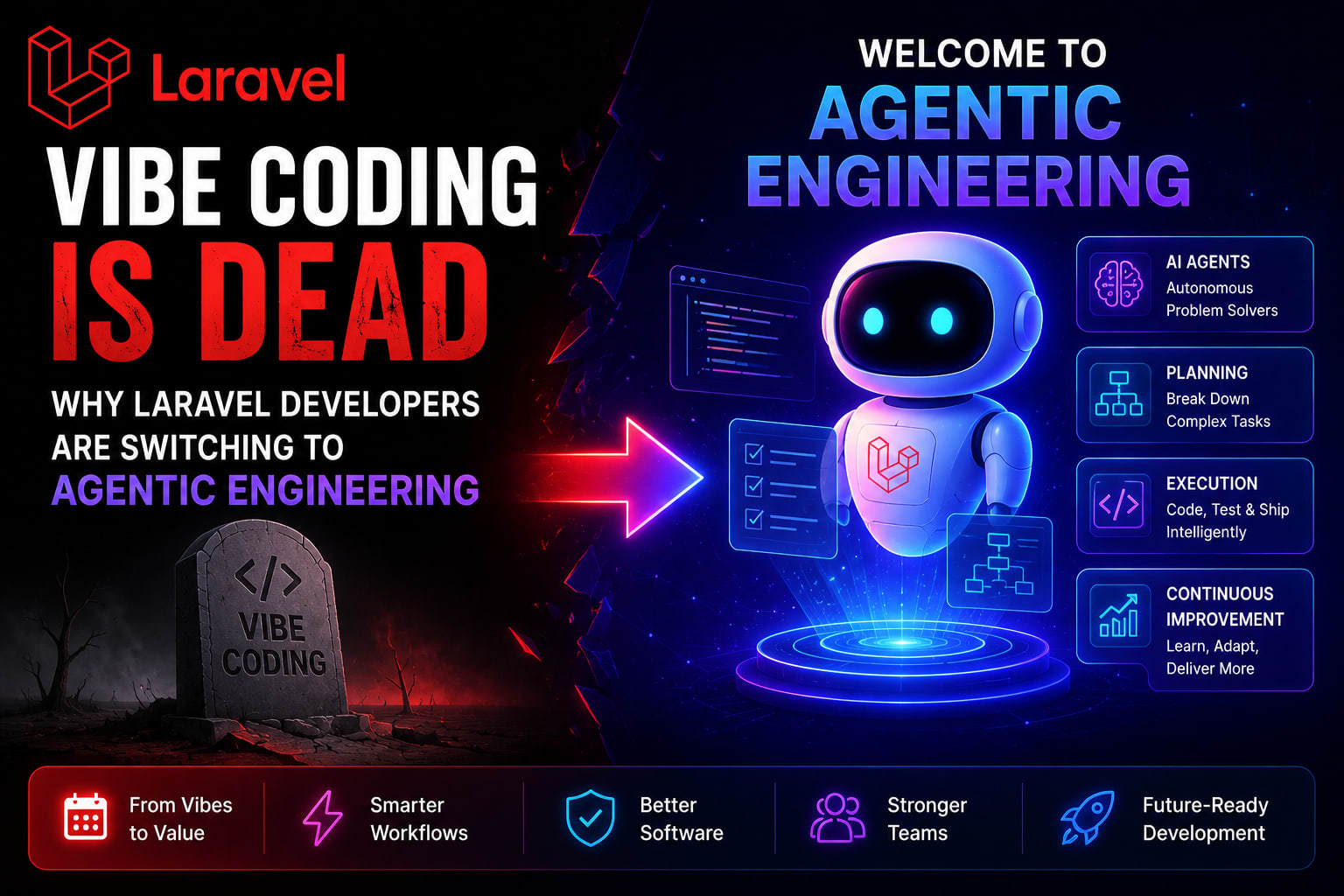
Vibe Coding is Dead — Why Laravel Developers Are Switching to Agentic Engineering in 2026
Let me tell you about a pattern I have watched repeat itself too many times in the last six months.
A developer sits down with Claude Code or Cursor. They describe a feature. The AI writes it. They run the tests — green. They push to staging. Everything looks fine. They ship.
Three weeks later, a real user hits the endpoint with a dataset that has ten thousand records. The page times out. The query log shows forty-seven database calls for a list that should have needed two. The Form Request validation was never added. The API response includes internal IDs the frontend should never see. The rate limiting was skipped entirely.
The code compiled. The tests passed. The demo looked perfect.
This is what vibe coding looks like when it meets production.
Where the Term Came From — and Where It Went
On February 4, 2026, Andrej Karpathy posted a thread on X that reshuffled the vocabulary of an entire industry. One year earlier, he had tossed off a "shower thoughts throwaway tweet" coining "vibe coding." That phrase spread through every Slack channel, conference keynote, and VC pitch deck on earth. The anniversary thread carried weight. SeoProfy
Karpathy wrote: "Many people have tried to come up with a better name for this to differentiate it from vibe coding, personally, my current favorite is agentic engineering." He broke the term into two halves. "Agentic" because the new default is that you are not writing the code directly. SeoProfy
Boris Cherny, who built Claude Code at Anthropic, said at Anthropic's developer conference that he finds the phrase "vibe coding" actively counterproductive — it implies sloppiness, impermanence, and a lack of rigor. He isn't sentimental about the term. When asked what should replace it, he reportedly put the question to Claude itself, which suggested "agentic engineering," echoing Karpathy. ALM Corp
When the person who built the tool that enabled vibe coding to go mainstream publicly distances himself from the term, that is a signal worth taking seriously.
What Vibe Coding Actually Is
Vibe coding is a development approach where you have natural language conversations with an AI and let it build an application for you without reviewing the generated code. The term was coined by Andrej Karpathy in a February 2025 tweet that described exactly this experience: you just talk, the AI builds, and you go with the flow. And honestly, for certain scenarios, that is perfectly fine. Cloudways
The key phrase in that definition is "without reviewing the generated code."
For a weekend project, a throwaway prototype, a personal tool you are the only user of — fine. Vibe coding gets you somewhere fast. The blast radius of a mistake is small. You can redo it.
Vibe coding fails when code moves from prototype to production. The technique skips design, skips review, and skips testing — which works for demos but collapses under the weight of real users, real security requirements, and real scale. The pattern repeats: it demos great, then reality arrives. Throughout 2025, the cycle played out on a loop. A developer would prompt an LLM, accept the output without reading it, paste error messages back in when something broke, and keep going. The demo looked great. The production deployment did not. SeoProfy
What Agentic Engineering Is
Vibe coding delegates code ownership to the AI. Agentic engineering keeps your engineering judgment in the driver's seat while AI agents handle the tedious work. For professional developers shipping production code, one of these approaches scales to enterprise requirements, and one does not. Cloudways
Agentic engineering emphasizes agentic programming as a tool rather than the force building the entire codebase end-to-end. You use AI for tasks such as code refactoring, generating boilerplate code and tests, performing lightweight code reviews, drafting documentation, scaffolding APIs and other low-risk tasks. Medium
The mental model shift is this: in vibe coding, the AI is the developer. In agentic engineering, you are the developer and the AI is a highly capable tool in your hands.
You need to have a higher level than that. This contrasts with agentic engineering where you are a professional software engineer. You understand security and maintainability and operations and performance. You are using these tools to the highest of your own ability. Appeaktech
The Laravel-Specific Failure Mode
Every general "vibe coding bad" article talks about the same abstract problems — missing tests, security holes, unmaintainable code. That is all true. But Laravel developers have a specific failure mode on top of those that most articles miss.
AI coding tools that are not Laravel-native generate technically correct PHP that breaks every Laravel convention in the project. You get DB::select() raw queries instead of Eloquent. You get controller logic that ignores Form Requests. You get suggestions that would have been correct in Laravel 8 but are outdated in Laravel 13. The gap is larger than most developers realize until they have wasted a full sprint cleaning up AI-generated code that technically compiles but breaks every convention. Kamruzzaman Polash
Here is what that looks like in a real codebase:
Vibe coded Laravel controller:
php
// What vibe coding produces
public function store(Request $request)
{
    $data = $request->all();

    // Validation dumped in the controller
    if (empty($data['title'])) {
        return response()->json(['error' => 'Title required'], 400);
    }

    // Raw query instead of Eloquent
    $post = DB::insert('INSERT INTO posts (title, body, user_id)
        VALUES (?, ?, ?)',
        [$data['title'], $data['body'], auth()->id()]
    );

    // Raw model return — no resource
    return response()->json($post);
}
Agentic engineered Laravel controller:
php
// What agentic engineering produces — with CLAUDE.md guidance
public function store(StorePostRequest $request): JsonResponse
{
    $post = $this->postService->create(
        $request->validated(),
        $request->user()
    );

    return (new PostResource($post))
        ->response()
        ->setStatusCode(201);
}
The first version compiles. The second version is Laravel. The difference is whether the engineer stayed in the driver's seat.
What the Shift Looks Like in Practice
Freek Van der Herten from Spatie — the team that maintains 300+ open source Laravel packages — wrote about exactly this shift. His workflow turns AI agents into a structured engineering process rather than a code generation machine. Impact Techlab
Here is the concrete workflow that separates agentic engineering from vibe coding for a Laravel developer:
Step 1 — Plan Before You Prompt
Never let the agent write code before it has laid out a plan. Describe the feature, then add: "Do not write any code yet. Lay out your approach, the files you will touch, the edge cases you need to handle, and any assumptions you are making."
This single step eliminates the majority of vibe coding problems. You catch wrong assumptions before they become wrong code.
Prompt: "I need to add a subscription billing feature.

Before writing anything:
- List the files you will create or modify
- Identify the edge cases (failed payments, expired cards, plan changes)
- Flag any assumptions you are making about our architecture
- Point out anything in CLAUDE.md that is relevant here

Do not write a single line of code until I approve the plan."
Step 2 — CLAUDE.md Teaches the Agent Your Stack
This is the most underused tool in Laravel development with AI. A well-written CLAUDE.md means the agent already knows your architecture before you type a word.
markdown
# Architecture — Laravel 13 + PostgreSQL 18

## Conventions Claude must follow
- Repository pattern — all database access through Repository classes
- Form Requests for all validation — never in Controllers
- API Resources for all JSON responses — never return raw models
- Service classes for business logic — Controllers stay thin
- Events for cross-cutting concerns — no direct Service calls from Observers

## Anti-patterns — flag these immediately
- DB::raw() without parameterized bindings
- env() calls outside the config/ directory
- Validation logic in Controller methods
- Returning $model->toArray() from API endpoints
- Missing $fillable on Eloquent models
With this in place, the agent does not need to be told "use Form Requests" on every prompt. It already knows.
Step 3 — Review Output as You Would a Junior Developer's PR
A good agentic engineer is part developer, part PM, part technical writer, part QA, part systems designer, and part person who stops the robot from doing something stupid. KrishaWeb
Every output gets reviewed. Not every keystroke — you are not watching the agent type — but every diff before it is committed. The same questions you would ask in a code review:
- Does this follow our architecture?
- Is there a security issue here?
- Will this break at scale?
- Are the edge cases handled?
- Is there a test for this?
Step 4 — Write Tests Before Implementation
Ask the agent to write the tests first, based on your specification. Then implement to make the tests pass. This is not just good TDD practice — it forces the agent to think about what the feature actually needs to do before it starts generating code.
"Write the feature tests for this endpoint first.
Cover: authenticated access, unauthorized access, validation failure,
successful creation, edge cases we discussed in the plan.
Do not implement the endpoint yet."
Step 5 — Pre-Commit Specialized Review
Before every commit, run a parallel subagent review:
markdown
# .claude/commands/review.md

Run specialized subagents in parallel. Each focuses on ONE lens only.

Subagent 1 — Laravel conventions
Check: Repository pattern followed, Form Requests used, API Resources
for responses, no business logic in Controllers, no env() outside config/

Subagent 2 — Security
Check: SQL injection, mass assignment, auth checks, rate limiting, input
validation, no sensitive data in responses

Subagent 3 — Performance
Check: N+1 queries, missing eager loading, unoptimized loops, missing
database indexes

Subagent 4 — Edge cases
Check: null handling, empty collections, concurrent access, large datasets

Flag critical issues. Do not approve with unresolved critical findings.
The Resume Question Nobody Wants to Answer
How do you put "vibe coding" on a resume without sounding like a person who has replaced engineering judgment with vibes and a subscription? A serious AI-native developer should show concrete projects: shipped MVPs, deployed services, agent workflows, code review loops, test automation, RAG systems, bots, integrations, production links, GitHub repos, databases, APIs, monitoring, and deployment history. KrishaWeb
A suspicious resume has only "Claude Code" and "vibe coding," with no stack, no Git, no database, no API, no deployment, no tests, and no proof of production reality. That is not an AI-native engineer. That is a passenger. KrishaWeb
For Laravel developers this is straightforward. Your GitHub tells the story. Repositories with migrations, models, Form Requests, API Resources, proper test suites, and deployment configuration — that is what agentic engineering produces. Repositories where every file looks like it was generated by a different person with different conventions and no tests — that is what vibe coding produces.
What This Is Not
This is not an argument against using AI heavily. That ship has sailed and the destination is good.
If vibe coding gets you started, and agentic engineering gives you leverage — then constraints define the boundary of truth, what you can actually achieve. Strategy sets direction. Agentic systems create leverage. Vibe gives you speed. Growithraju
Use vibe coding for what it is good at: prototyping a new idea quickly, exploring an unfamiliar API, scaffolding something you are going to throw away. The moment you are building something that real users will depend on — switch modes. Stay in the driver's seat.
Boris Cherny's broader prediction that the job title "software engineer" will begin to disappear in 2026, absorbed into more hybrid roles, is a signal that the identity of the profession is in transition, not just its tooling. His most pointed observation: engineers at Anthropic are no longer writing code. ALM Corp
They are still engineering. They are doing it with agents instead of fingers on keyboards. The judgment, the architecture decisions, the security thinking, the understanding of what the code needs to do — that is still human. The typing is not.
That is agentic engineering. And that is exactly where Laravel development is heading.
The Practical Summary
The difference between vibe coding and agentic engineering is not how much AI you use. It is whether you stay accountable for the output.
Vibe coding: AI owns the code. You ship what it gives you.
Agentic engineering: You own the code. AI helps you build it faster.
For a Laravel developer in 2026, the second approach produces code that looks like Laravel, follows your conventions, handles edge cases, has tests, and survives contact with real users.
The first approach produces a demo that works until it does not.
You already know which one belongs in production.
Tushar Modi — Full Stack Developer, Jaipur tusharmodi.in