
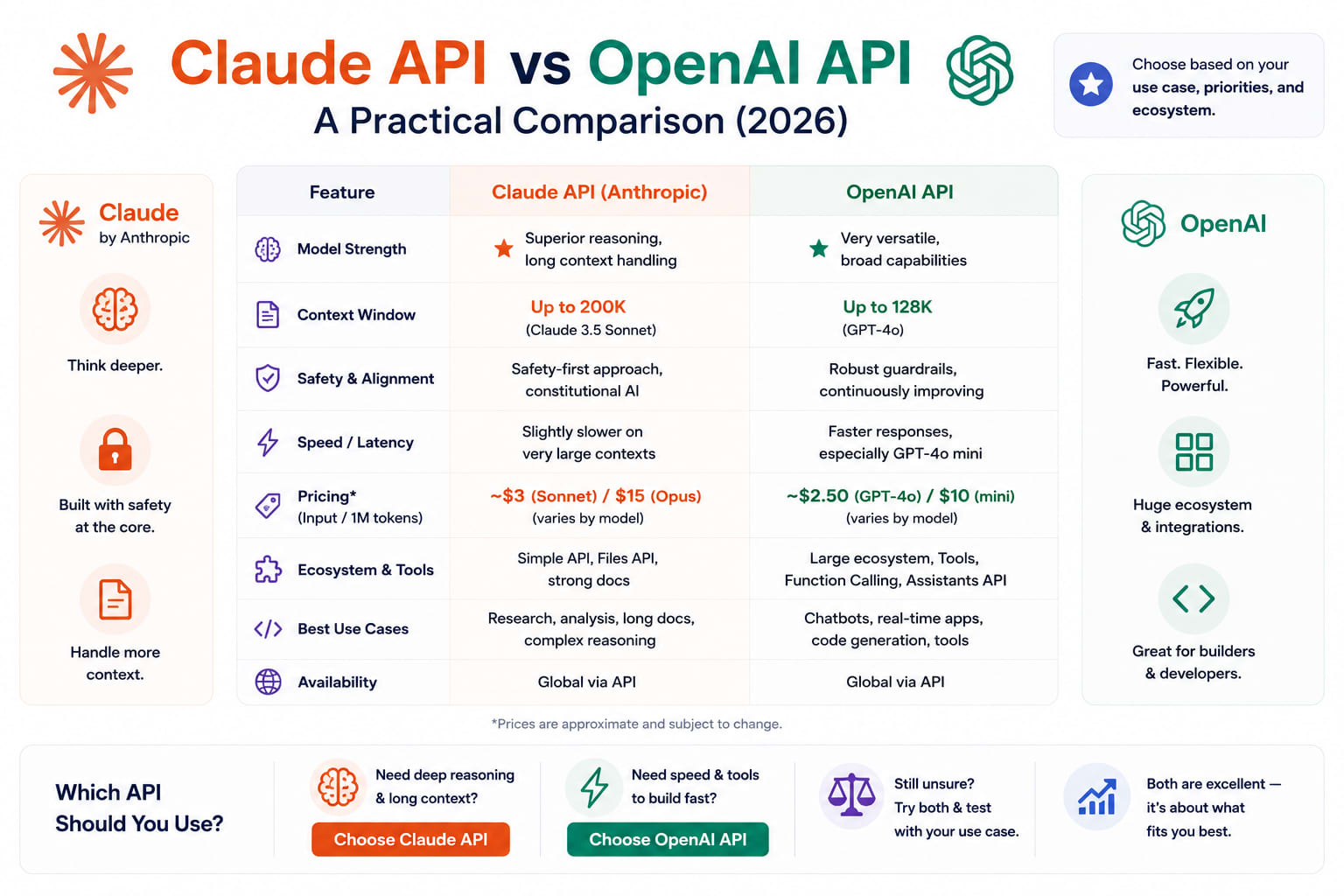
Claude API vs OpenAI API: A Practical Comparison
Both APIs solve the same basic problem — text in, intelligent response out — but the decision between them usually comes down to a handful of concrete factors: cost per task, how well a model actually codes, how tool-calling integrates into your stack, and what context window your use case actually needs. Here's the practical breakdown, not the marketing one.
Table of Contents
- Quick Answer
- Current Model Lineups
- Pricing Comparison
- Context Windows and Long-Context Handling
- Coding and Agentic Performance
- Tool Use: MCP vs Function Calling
- Multimodal Capabilities
- Safety and Design Philosophy
- Which One Fits Your Use Case
- A Note on How Fast This Changes
- Wrapping Up
1. Quick Answer
Neither API is categorically "better" — they're optimized for slightly different things. Claude's lineup tends to lead on coding benchmarks and offers flat-rate long context across more of its tiers. OpenAI runs the widest pricing ladder in the industry, with more model tiers to route between, and the largest existing tool/plugin ecosystem simply because of how long it's been the default choice for so many teams. If your workload is genuinely price-sensitive at high volume, OpenAI's cheapest tiers usually win. If it's coding, agentic tool use, or long-document reasoning, Claude tends to have the edge.
2. Current Model Lineups
Anthropic (Claude): the current lineup runs Claude Haiku 4.5 (fast, cheap tier), Claude Sonnet 5 (the default price-to-performance tier), and Claude Opus 4.8 (flagship reasoning and coding). Above Opus sits a separate Mythos-class tier represented publicly by Claude Fable 5, aimed at the hardest reasoning and long-horizon agentic work.
OpenAI (GPT): OpenAI runs a noticeably wider ladder — recent releases include the GPT-5.6 family (Sol, Terra, Luna) alongside GPT-5.5 and GPT-5.5 Pro, plus older GPT-5.4 and GPT-5.1 tiers still live on the pricing page, and GPT-5.3 Codex specifically tuned for coding agents. More tiers mean more routing flexibility, but also more decisions about which model fits which task.
3. Pricing Comparison
Roughly, as of mid-2026, per million tokens (input/output):
| Tier | Anthropic | OpenAI |
|---|---|---|
| Budget | Haiku 4.5 — $1 / $5 | GPT-5.6 Luna — $1 / $6 |
| Mid (default) | Sonnet 5 — $2–3 / $10–15 | GPT-5.6 Terra — $2.50 / $15 |
| Flagship | Opus 4.8 — $5 / $25 | GPT-5.5 / GPT-5.6 Sol — $5 / $30 |
| Top-tier | Fable 5 — $10 / $50 | GPT-5.5 Pro — $30 / $180 |
4. Context Windows and Long-Context Handling
Anthropic offers a 1M-token context window at a flat rate — no separate pricing tier — across Opus 4.8, Sonnet 5, and its Fable/Mythos-class models. OpenAI's GPT-5.6 family also ships with a 1M-token context window, but some OpenAI models apply a pricing surcharge once a request crosses roughly 272K input tokens, billing the overage at a higher rate. If your workload regularly processes very long documents or codebases, check whether your specific model tier on either side charges a long-context premium before assuming flat-rate pricing.
5. Coding and Agentic Performance
This is where the two philosophies diverge the most. Claude's recent Opus releases have consistently posted strong results on SWE-bench Verified (a benchmark measuring real-world software engineering task completion), and Claude models are the default choice inside a large share of AI coding tools. OpenAI's GPT-5.3 Codex and GPT-5.6 Sol are built and marketed specifically for coding agents and tend to perform well on similar benchmarks, with OpenAI's broader ecosystem giving it an edge in some IDE and agent-framework integrations simply due to market presence.
In practice: both are genuinely strong at code generation, debugging, and multi-step agentic tasks. The differences show up more in tool-use ergonomics and pricing at scale than in raw code quality for most everyday tasks.
6. Tool Use: MCP vs Function Calling
Both APIs support structured tool use, but the underlying model differs:
- Claude uses the Model Context Protocol (MCP) — an open standard for connecting a model to external tools and data sources (databases, APIs, file systems) in a way that's meant to be reusable across different MCP-compatible clients, not just one API.
- OpenAI uses function calling and built-in tools (Code Interpreter, File Search, web search) integrated directly into its Responses/Assistants-style API surface.
If you're building something that needs to plug into a growing ecosystem of shared, reusable tool integrations, MCP's open-standard approach is worth a look. If you want tools that are already deeply built into one vendor's API surface with minimal setup, OpenAI's built-in tools are a faster starting point.
7. Multimodal Capabilities
Both platforms handle image and document input well — reading screenshots, scanned PDFs, charts, and diagrams. Vision quality between the two is genuinely close for most everyday use cases (OCR, describing an image, extracting structured data from a scanned form). Neither is a clear, consistent winner here across every benchmark; small differences show up depending on the specific vision task.
8. Safety and Design Philosophy
Anthropic was founded specifically around AI safety research, and that shows up in Claude's more cautious default behavior around certain sensitive requests, alongside heavier published research on interpretability. OpenAI ships safety tooling too — moderation endpoints, usage policies — but has generally positioned itself with a broader consumer and enterprise product surface (ChatGPT's scale being the clearest example). Neither approach is objectively "more correct" — it depends on whether your product needs a model that leans more permissive or more conservative by default, and both are configurable to a degree via system prompts and usage policies.
9. Which One Fits Your Use Case
- High-volume, cost-sensitive classification/extraction: OpenAI's cheapest tiers (Luna, GPT-5.4 nano) or Claude Haiku 4.5 — check current per-task pricing on both, this shifts often
- Coding assistants and agentic dev tools: Either is a strong choice; Claude's Opus line and OpenAI's Codex-branded models are both purpose-built here
- Long-document analysis (contracts, codebases, research papers): Claude's flat-rate 1M context across more tiers is the simpler pricing story
- Teams already deep in one ecosystem: Sticking with whichever API your existing tools, SDKs, and integrations already support usually beats switching for a marginal benchmark difference
- Reusable tool integrations across multiple AI products: MCP's open-standard design is worth evaluating if this matters to your architecture
10. A Note on How Fast This Changes
Both companies ship new model versions and pricing changes every few weeks — the specific numbers in this post will likely be outdated within a quarter. Before committing budget, check the current rate cards directly: Anthropic's pricing page at platform.claude.com, and OpenAI's at platform.openai.com. Treat every comparison post, including this one, as a snapshot rather than a permanent reference.
11. Wrapping Up
The honest answer to "which API should I use" is: prototype on both for your actual workload before deciding. Benchmarks and pricing tables are useful for narrowing the field, but the model that handles your specific prompts, tool calls, and edge cases best is something you'll only know by testing it against your real use case — not by reading a comparison table, including this one.